

President Donald Trump formally unveiled his proposed Board of Peace on Thursday, pitching it as a new international body to secure a lasting peace in Gaza — and potentially reshape how global conflicts are handled.
HOW WE GOT HERE: The board was initially conceived as a new governance framework for Gaza. But, Trump has ambitions past Gaza.
“Once this board is completely formed, we can do pretty much whatever we want to do. And we’ll do it in conjunction with the United Nations,” Trump said, adding that while many of the 59 leaders involved are “very popular,” others are “not so popular.”
Invitees included dozens of world leaders ranging from Pope Leo XIV to Russia's Vladimir Putin. A number of countries have already signed on. At least 19 leaders were on stage for the announcement — including from Argentina, Armenia, Hungary, Indonesia, Kosovo, Pakistan, Qatar, Saudi Arabia, and the UAE.
But several U.S. allies were not in attendance, and have major concerns about the board, including Canada, the United Kingdom, France, Norway, and Sweden. There are also questions about whether the board could act as a rival to the UN.
WHO CAN JOIN?
Trump, as chairman, would hold the power to decide the agenda and remove members — subject to a veto by a two-thirds majority of member states. Members serve for three years, but can pay $1 billion for permanent membership, according to a draft charter. The membership fees will reportedly go toward operating the board.
Russia has signaled it may contribute the $1 billion, but only if its assets currently frozen in the U.S. are released.
While Trump has framed the Board of Peace as a vehicle for stability, specifics about enforcement, funding, and coordination with existing international institutions remain unclear.
GAZA PLAN
After the Board of Peace signing Thursday, Trump’s son-in-law Jared Kushner unveiled a sweeping $25 billion vision for Gaza, featuring coastal high-rises, tourism zones, and industrial hubs. He estimated parts of the plan could be completed within two to three years. He insisted there is “no Plan B” for the territory’s future.

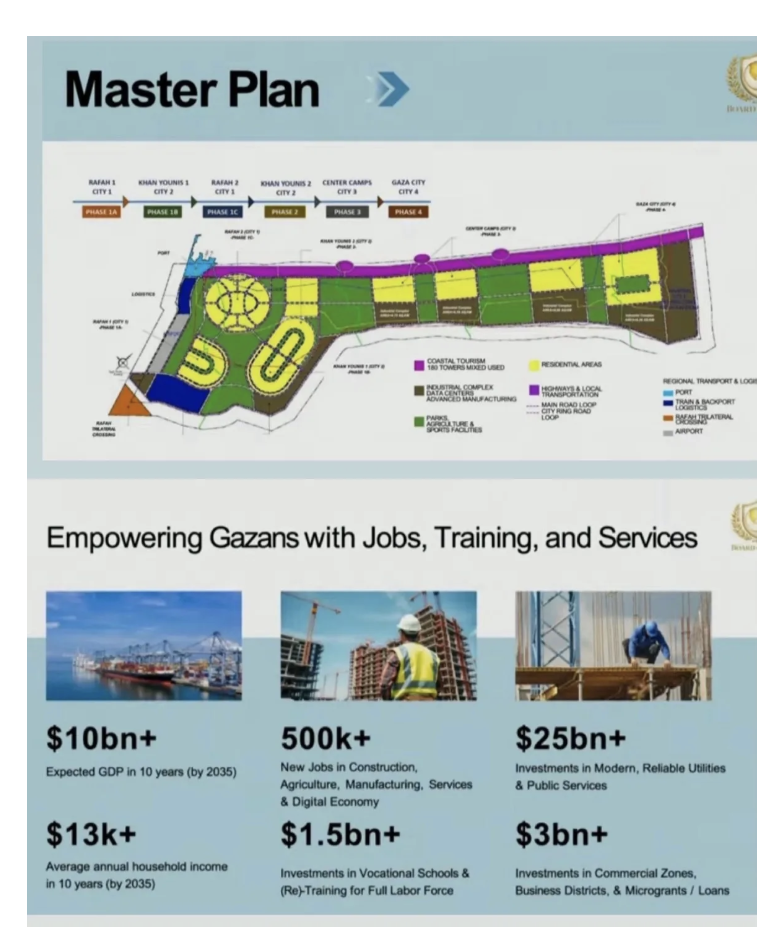
Kushner, who helped broker the Gaza ceasefire, said the next phase would involve working with Hamas on demilitarization — which the terrorist group still has not agreed to. The 100-day plan also includes restoration of basic infrastructure like water, sewage, and electric systems, in addition to more flow of goods into the enclave.
Kushner argued that Gaza has “amazing potential” and could reach full employment once security and governance are established, adding that the White House wants to bring “free market economy principles to Gaza.” There is still little agreement on who will govern the territory in this post-war plan, raising questions about the possibilities of this next phase.
WATCHING IRAN
A U.S. aircraft carrier strike group, led by the USS Abraham Lincoln, is set to arrive in the Middle East in the coming days. Trump called it “a massive armada” heading in the direction of the Iranian regime. On Thursday, he warned that the U.S. is watching Iran “very closely.”
U.S. Special Envoy Steve Witkoff hinted Wednesday that “discussions” between the U.S. and Iran had “resulted in the Iranian statement that the killings will stop,” referring to the crackdown that could have killed more than 20,000 people.