
Top Intel Democrat Calls For Boat-Strike Video To Be Released As Lawmakers Threaten Hegseth’s Budget
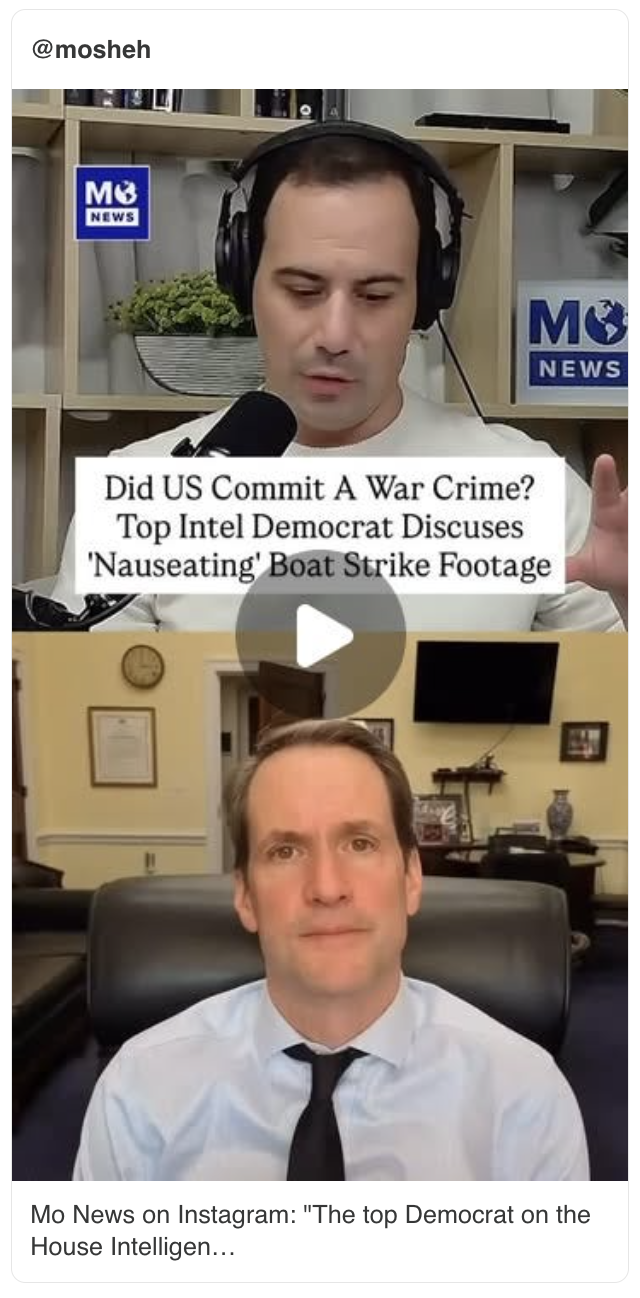
Congress is using its annual defense policy bill to pressure the Pentagon into releasing unedited video and orders from the Caribbean boat strikes that have killed at least 87 people since September.
At stake? Lawmakers added a provision that would withhold 25% of Defense Secretary Pete Hegseth’s travel budget until he turns over the documents to the House and Senate Armed Services Committees.
The legislation is expected to clear the House later this week, followed by the Senate.
Will he or won’t he? Over the weekend, Hegseth would not commit to releasing the video, citing potential safety concerns for troops. President Trump has said he would have “no problem” doing so, but said the decision is up to Hegseth.
In a Mo News Interview, the top Democrat on the House Intelligence Committee, Rep. Jim Himes (D-CT), called for the public release of video of the Sept. 2 U.S. military strikes on an alleged drug boat in the Caribbean. Speaking to Mo News’ Mosheh Oinounou on Tuesday, Himes called the footage nauseating to watch and possible murder.
INSIDE THE STRIKE
Himes said the video, which he viewed during a classified briefing last week with other Intelligence Committee members, showed two survivors clinging to a small piece of wreckage after their drug-smuggling boat had already been destroyed and set on fire.
The men, he said, had no weapons, radios, or way to signal when multiple munitions were launched.
His take is in stark contrast to how Sen. Tom Cotton (R-AR), who heads the Senate Intelligence Committee, framed the strikes — calling them lawful and saying the survivors were “trying to flip a boat loaded with drugs bound for the United States back over so they could stay in the fight.”
Himes argued that killing incapacitated people endangers U.S. troops on future missions, since it erodes norms and the laws of war around surrender and humane treatment.
BIGGER PICTURE
So is it a war crime? “It’s not a legitimate war, it’s sort of hard to talk about war crimes,” Himes said, noting that Congress has not authorized these war-like strikes. “This points you back to a word that’s even more uncomfortable: the illegal and premeditated killing of a human being, known as a murder.”
He rejected Trump administration comparisons between Caribbean boat strikes and U.S. counterterrorism operations against ISIS and other groups.
On Saturday, Defense Secretary Pete Hegseth said, “These narco-terrorists are the al-Qaida of our hemisphere, and we are hunting them with the same sophistication and precision that we hunted al-Qaida.” He and President Trump have called the people on the boats “narco-terrorists“ and moved to label cartels as foreign terrorist organizations.
Himes says there are major legal issues with that framing. First, Congress authorized the war on terror, but has not authorized these strikes. He also argues that terrorists and cartels pose fundamentally different threats: terrorists aim to destroy the U.S., while cartels aim to make money by selling drugs. Though, those drugs also ultimately harm Americans.
Nearly 3,000 people died in the 9/11 attacks that sparked the War on Terror, while more than 100,000 people die annually from drug overdoses.
Himes said the appropriate response to cartels is law enforcement— arresting, prosecuting, and interrogating traffickers to dismantle their networks— not military force.