
Young People Are More Likely To Hold Anti-Jewish Views, Regardless Of Politics

“American antisemitism is not primarily a partisan phenomenon, as it is often framed in popular discourse, but a generational one,” writes Yair Rosenberg in an article in The Atlantic, published Monday. The piece is headlined, ‘The More I’m Around Young People, the More Panicked I Am.’
Rosenberg points to research that collectively suggests America is becoming more antisemitic because its young people are becoming more antisemitic. This finding flies in the face of conventional wisdom that anti-Jewish prejudice, like other forms of prejudice, will eventually die out.
WHAT RECENT POLLING SHOWS
A recent survey from the Yale Youth Poll found that younger voters are more likely to hold antisemitic views than older voters.
When asked to choose whether Jews have had a positive, neutral, or negative impact on the United States, just 8% of respondents said “negative.” But among 18-22 year olds, that number was 18%.
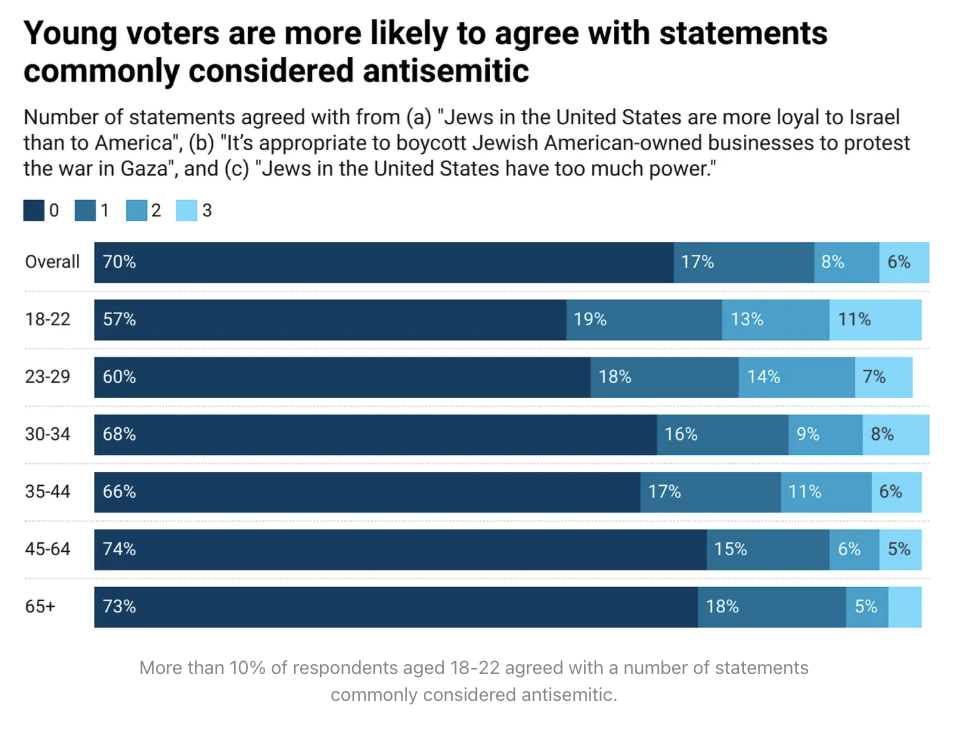
Younger voters are also more likely to agree with three statements that are commonly considered antisemitic. These statements include…
Jews in the United States are more loyal to Israel than to America.
It’s appropriate to boycott Jewish American-owned businesses to protest the war in Gaza.
Jews in the United States have too much power.
Among all voters, 70% agreed with none of these three items. But the same is true for only 57% of 18-22 year olds and 60% of 23-29 year olds.
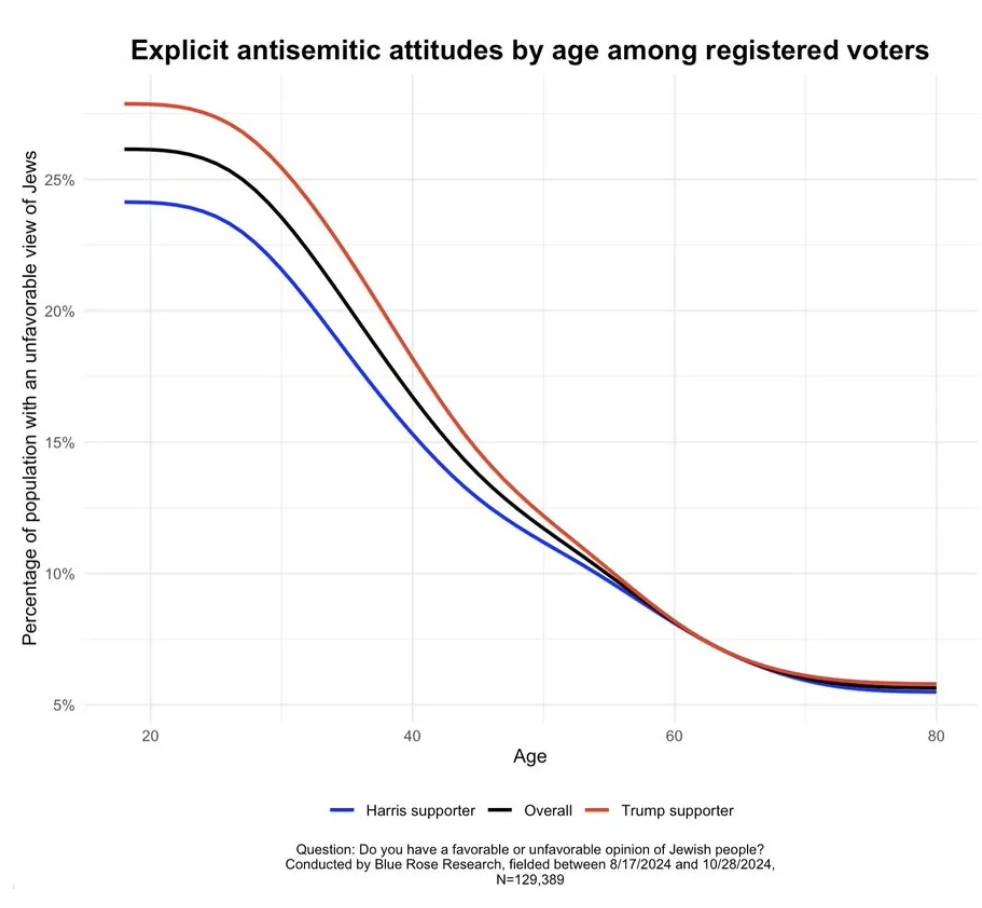
The article also quotes a separate 2024 study from the group Blue Rose Research that found that a quarter of people younger than 25 held an “unfavorable opinion” of “Jewish people” —with the question using the exact term “Jewish people,” not “Israelis” or “Zionists.”
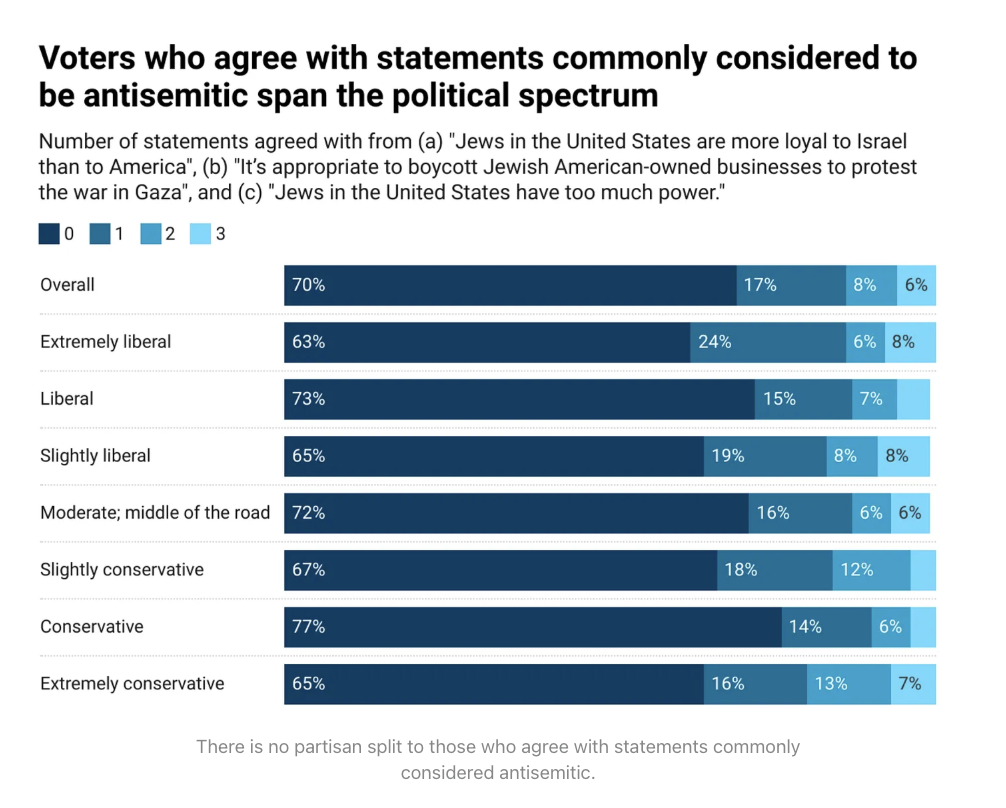
The poll found no major divide in opinions among supporters of President Trump or former VP Kamala Harris in the 2024 election.
POSSIBLE EXPLANATIONS
As Rosenberg writes, “Any generational shift this dramatic has more than one cause.” For one, younger people have no first hand experience with WWII and the Holocaust, which positively shaped the previous generation’s attitude toward Jews.
Also, younger Americans are likely getting their news from social media platforms, which often advantage the extreme opinions, conspiracy theories, and conflict-stoking content that drive engagement.”
“Young people also tend to be more critical of Israel than older generation. They’re likely to consume anti-Israel content on social media, which will then ‘funnel some of those users toward anti-Semitic material—a sort of algorithmic escalator that ends up radicalizing a percentage of them.”
ON THE PLUS SIDE: Survey data show that antisemitic attitudes remain a minority prejudice, even among young people, Rosenberg added.
VANCE SAYS THEY’RE DANCING AROUND THE ISSUE
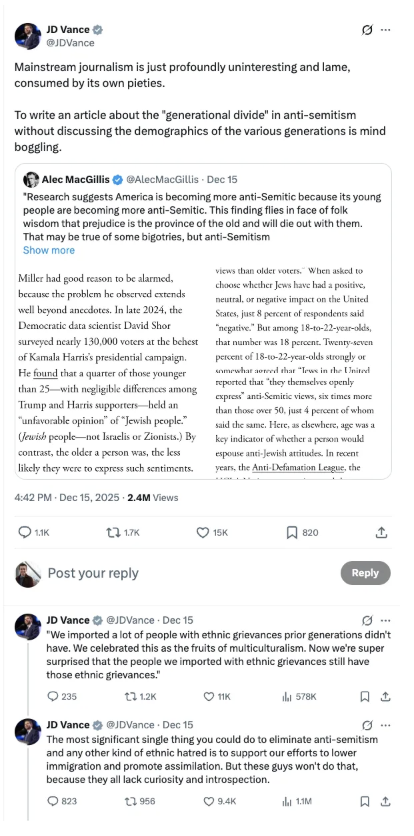
Vice President JD Vance weighed in on the article on X, criticizing it for not directly naming what he believes to be driving the issue: “the demographics” of the younger generation of Americans compared to older Americans.
He says the U.S. “imported a lot of people with ethnic grievances prior generations didn’t have,” and argues that “the most significant single thing you could do to eliminate anti-semitism and any other kind of ethnic hatred is to support our efforts to lower immigration and promote assimilation.”
BIG PICTURE
Rosenberg’s article comes as attacks motivated by anti-Israel or antisemitic sentiment have spiked globally since the October 7th, 2023, Hamas attacks.
On Sunday, a gunmen opened fire at a Hanukkah celebration at Bondi Beach in Sydney, killing at least 15 people.
In the U.S., two Israeli embassy aides were shot and killed as they were exiting an event at the Capital Jewish Museum in May.
In June, an individual firebombed a peaceful demonstration in Boulder, Colorado, calling for the return of Israeli hostages. One person was killed and 15 injured.
According to the Anti-Defamation League’s State of Antisemitism in America 2024 report, one third of American Jews said they have personally been the victim of antisemitism, whether in-person or online, at least once over the past year.