
Supreme Court Majority Appears Ready To Uphold State Bans On Transgender Athletes
A majority of Supreme Court justices appeared skeptical of striking down state bans on transgender athletes competing in girls’ sports on Tuesday during oral arguments.
REWIND: The cases from Idaho and West Virginia. Idaho became the first state to enact a ban on athletes who are designated boys at birth from competing in girls sports in 2020, followed by West Virginia in 2021. Now, 27 states have similar bans.
Lower courts sided with the transgender athletes challenging the bans.
On Tuesday, at least five of the Supreme Court’s six conservative justices signaled they may uphold the state bans — signaling they do not violate the Fourteenth Amendment’s Equal Protection Clause, which requires states to provide “equal protection of the laws,” or Title IX, the landmark civil rights law from 1972 that prohibits sex discrimination in education, which helped fuel the growth of girls’ and women’s sports.
INSIDE THE COURTROOM
In the case of Becky Pepper-Jackson, a West Virginia student, she socially transitioned in third grade and began puberty blockers before male puberty. She later started estrogen in sixth grade, meaning — according to her legal brief — she never underwent male puberty. Science supports that puberty catapults boys far ahead of girls in physical performance.
Here’s some from three of the courts’ conservative majority:
Justice Brett Kavanaugh, a longtime girls’ basketball coach, pressed lawyers on the real-world impacts of transgender participation in sports, arguing that many teams are “zero-sum” — where an athlete’s opportunity can come at another’s expense.
Joshua Block, arguing for the American Civil Liberties Union, countered that West Virginia's ban denies equal opportunity — even in cases where there is no competitive advantage.
During arguments, Kavanaugh praised Title IX for helping “make girls’ and women’s sports equal,” and noted that he sees the law in effect “every night when I walk into my house as my daughters are getting back from lacrosse or basketball or hockey practice.”
Justice Neil Gorsuch wrote the majority opinion in Bostock v. Clayton County, the 2020 decision that protects transgender workers under Title VII. He was joined by Chief Justice John Roberts and the court's four liberal justices at the time. On Tuesday, Roberts indicated that Bostock may not apply in these cases: “The question here is whether a sex-based classification is necessarily a transgender classification.”
Roberts also cautioned that allowing challenges from a very small group “would have to apply across board and not simply to the area of athletics.”
Gorsuch was the only conservative justice who seemed open to the arguments of the student plaintiffs. He noted that transgender people have a documented history of discrimination in the U.S.
The three liberal justices suggested that even if the transgender sports bans are generally constitutional, the plaintiffs could still challenge them by showing they personally do not pose an unfair advantage.
BIGGER PICTURE
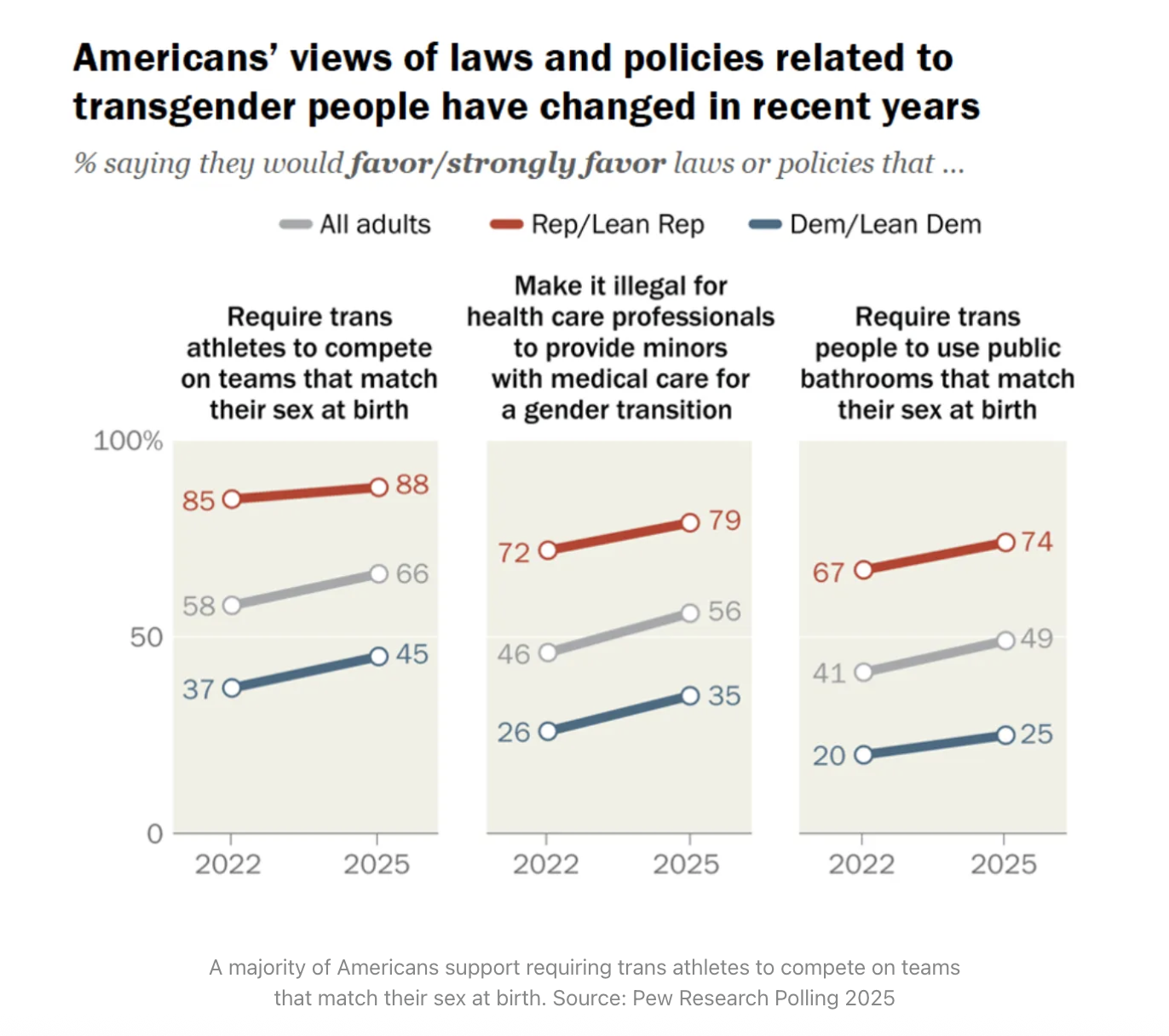
Sports have become a key battleground in broader legal and political fights over transgender rights in the U.S. Recent polling shows that the vast majority of Americans belive trans athletes should be required to compete on teams that match their sex at birth.