
Job Layoffs Top 1 Million In 2025 As Trump Faces Growing Economic Backlash
More than a million people were laid off from their jobs in 2025, according to new data — the highest number since the peak of the pandemic in 2020. It comes as Americans are feeling financially stretched, with an increasing number blaming President Trump for economic instability and high prices on goods.
Trump is feeling the pressure: He signed a long-awaited farm aid package Monday to offset tariff pain and low crop prices that have led to high food prices; on Tuesday, he’s headed to Pennsylvania to tout his economic agenda ahead of the 2026 midterms. At the same time, just last week, Trump called any criticism regarding affordability during his administration a “con job” by Democrats.
Meanwhile, economists warn of more price increases coming as soon as January, when holiday discounts end and retailers run low on inventory they bought at pre-tariff prices.
BEHIND THE JOB LOSSES
From January to November 2025, companies have cut nearly 1.2 million jobs, according to new numbers from outplacement firm Challenger, Gray & Christmas. That’s up 54% from 2024 and the highest since the 2020. (If you set 2020 aside as a pandemic outlier, it’s the highest since 2009 — just after the financial crash.)
Companies attribute the cuts primarily to corporate restructuring, artificial intelligence, and Trump’s tariffs. Small businesses have been leading the decline in jobs, saying tariffs have hit them particularly hard.
The tech squeeze: More than 10% of job losses were in the tech industry, and nearly 55,000 job cut announcements were reportedly tied to AI this year.
The new data comes as Americans are voicing increased frustration about the state of the economy under President Trump.
THE BLAME GAME
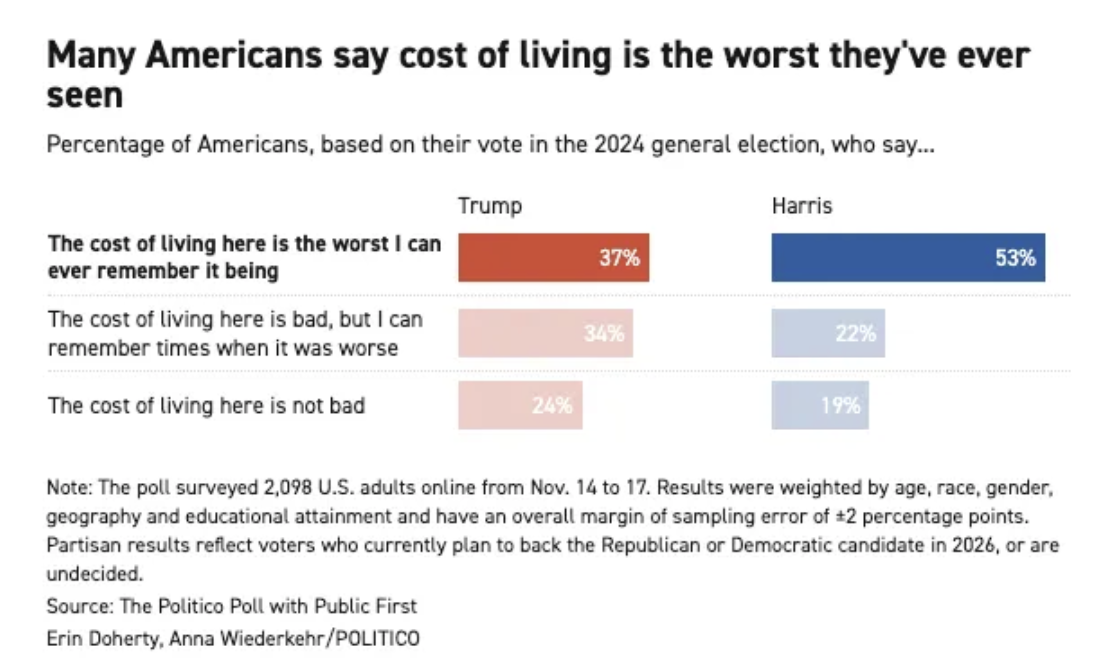
A recent Politico poll revealed an increasing number of Americans blame President Trump for the high costs they’re experiencing at grocery stores, while holiday shopping, and in virtually all aspects of life. Nearly half of those surveyed said the cost of living for Americans feels the worst they can ever remember it — including nearly 40% of 2024 Trump voters.
More Americans say Trump holds most or all responsibility for the economy (46%) than those that believe Biden does (29%). Notably, a quarter of Trump voters say the economy is Trump’s fault.
Still, three out of four Trump voters say they trust the Republican Party over Democrats to ease the overall cost of living; though that number drops when you remove self-described MAGA Republicans from the equation.
Why it matters: The numbers reveal a problem for Trump and Republicans ahead of the 2026 midterm elections. Democrats successfully captured frustrations about the economy to win key races in the 2025 off-election year with campaigns focused on the affordability crisis. According to the latest Yale Youth Poll, the cost of living is the top issue for 91% of voters aged 18-34.
Damage control: In the same week Trump called himself the “affordability president,” he also told reporters during a cabinet meeting that the word “affordability” is a “con job by Democrats.” The Washington Post reported that Trump’s advisors have been urging him to promote his administration’s accomplishments to Americans — such as lower prices on gas, eggs, and some medications. He’s headed to northeast Pennsylvania Tuesday to do just that.
MORE PAIN COMING?
Next year could bring a new wave of pain for consumers, as major retailers warn of price increases after months of Trump’s tariffs. Trump has placed tariffs on nearly all goods imported to the U.S. — the average rate is about 17%, the highest since the 1930s — affecting everything from coffee to furniture to cars.
So far, companies have been able to keep prices relatively low, only passing on about half the cost of tariffs to consumers, according analysis by Goldman Sachs. But that could change in the new year.
U.S. Trade Representative Jamieson Greer told Politico tariffs aren’t the issue: “People are worried about housing, they’re worried about health care — things we don’t import,” he said. “Where trade comes into it is when you have a trade system in place that protects U.S. jobs, you get higher incomes.”
Yet, amid economic uncertainty and job losses, Americans have continued to spend. More than $44 billion was spent over a 5-day stretch during Thanksgiving weekend (including Black Friday and Cyber Monday)—a 9% increase over last year.