

The U.S.–Israeli war with Iran has created a power vacuum in Iran after the assassination of Supreme Leader Ayatollah Ali Khamenei on Saturday, and President Trump says he wants a role in choosing Iran’s next leader.
In interviews Thursday morning, Trump pointed to Mojtaba Khamenei, the son of the late supreme leader, as the likely successor, but labeled him "unacceptable."
WHAT HE WANTS: “Someone that will bring harmony and peace to Iran,” Trump said, while also signaling that he wants a leader willing to work with Washington.
Trump pointed to Venezuela’s Delcy Rodríguez as an example. On Wednesday he posted that she is “doing a great job, and working with U.S. Representatives very well,” after the American military arrested her predecessor, Nicolás Maduro, in January.
With the war in its sixth day, the Iranian regime launched a new wave of retaliatory drone strikes throughout the Middle East. However, Gen. Dan Caine, the chairman of the Joint Chiefs of Staff, said Thursday evening that Iranian ballistic missile attacks are down more than 90% since the first day of the war, while drone attacks have dropped more than 80%.

ON THE GROUND
The Pentagon and at least one Persian Gulf country is looking at buying Ukrainian-made interceptor drones designed to shoot down Iranian Shahed drones, according to new reporting. Each Shahed costs about $20,000 to $50,000 to make, but millions of dollars to shoot down.
DEFENSIVE MOVE: Several regional governments are using expensive air defense systems to stop the drones, but stockpiles are shrinking and replacements take years to build.
Ukraine has developed a cheaper defense against Iranian-designed Shahed drones, which the Russian military has used to target Ukrainian cities. Kyiv’s mass-produced interceptor drones costing only a few thousand dollars, which can chase down and destroy the slow-moving Shaheds.
AI & WAR: The Pentagon was reportedly relying on Claude — one of the country’s most advanced AI tools developed by Anthropic — during the opening phase of the U.S. military’s campaign in Iran, hours after Trump declared that the federal government would end its use of the tools.
The U.S. Central Command in the Middle East uses the tool for intelligence assessments, target identification and simulating battle scenarios, according to Wall Street Journal reporting. Anthropic and the Pentagon clashed last week after the company outlined guardrails for how its AI could be used. The two sides met Thursday, and the Defense Department told the company it designated Anthropic’s product a supply-chain risk.
THE WAR’S $$ IMPACT
Prices are rising around the world as the war in Iran disrupts trade and shipping in the Middle East.
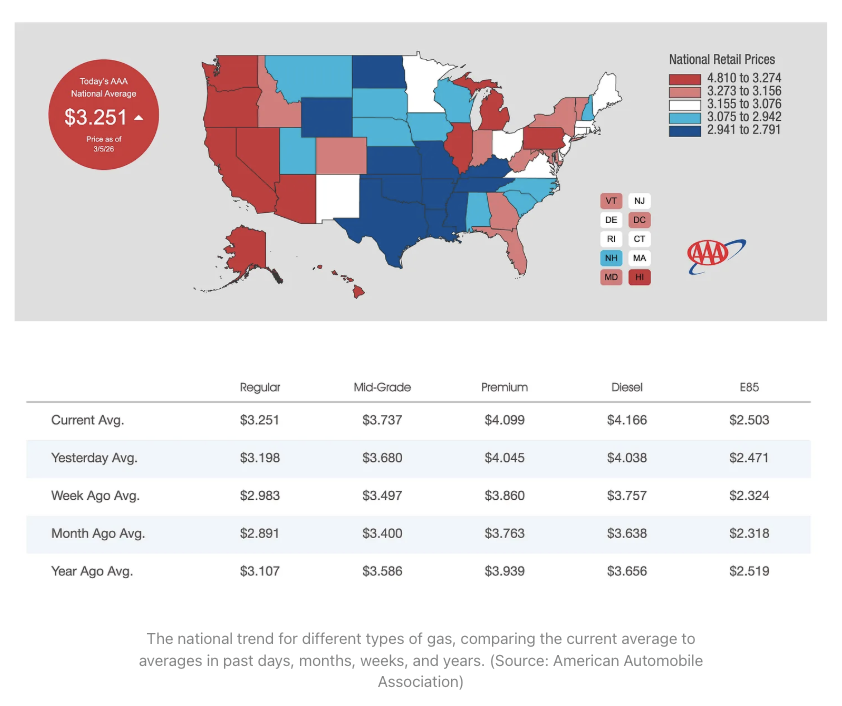
In the U.S., the price of gas continued to rise Thursday, with an average gallon of regular gas costing $3.25 nationwide — that’s up more than 25 cents from a week ago.
THE BLOCKAGE: The Strait of Hormuz, the narrow waterway off Iran’s southern coast, is a crucial shipping route for about a fifth of the world’s crude oil and natural gas exports. Traffic through the strait has effectively ground to a halt since the war started. While the U.S. does rely on energy from there, it is impacted by the global prices.
In the short term, analysts expect prices to rise further. But if Trump is able to open Iran’s oil market to the U.S., that could help bring gas prices down in the long term.
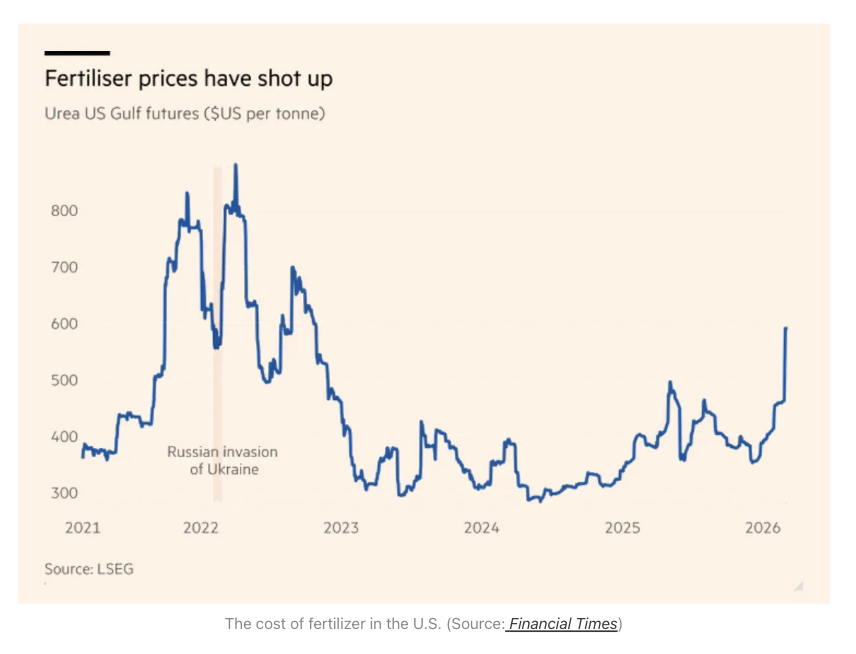
FOOD PRICES ⬆️ Prices of food could rise too — not just because of higher fuel prices, but because the Middle East is one of the world’s largest producers of fertilizer.
Iran is a leading producer of Urea, which is the world’s most widely used fertilizer and accounts for about half of global food production. About a third (35%) of global urea exports pass through the Strait of Hormuz.
The route also handles just under half (45%) of global sulphur exports, a key ingredient used to produce phosphate fertilizers, as well as significant volumes of ammonia, which is used in nitrogen fertilizers.
Bottom line: As Trump pushes an affordability agenda ahead of the midterms, keeping Middle East exports flowing will be key to limiting price increases at home.
A DIVIDED SENATE AND AMERICAN PUBLIC
Republicans are much more likely to support America’s war efforts to rid Iran of nuclear capabilities than Democrats.
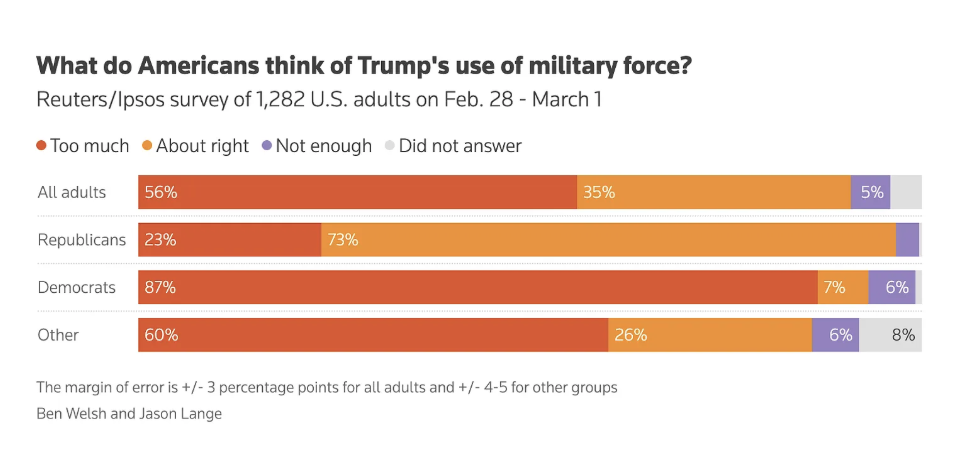
A new Reuters/IPSOS poll of around 1,200 adults shows that only one in four Americans say they back the U.S. strikes on Iran. The vast majority of Democrats (87%) say Trump is too willing to use military force, whereas only around a quarter (23%) of Republicans say the same.
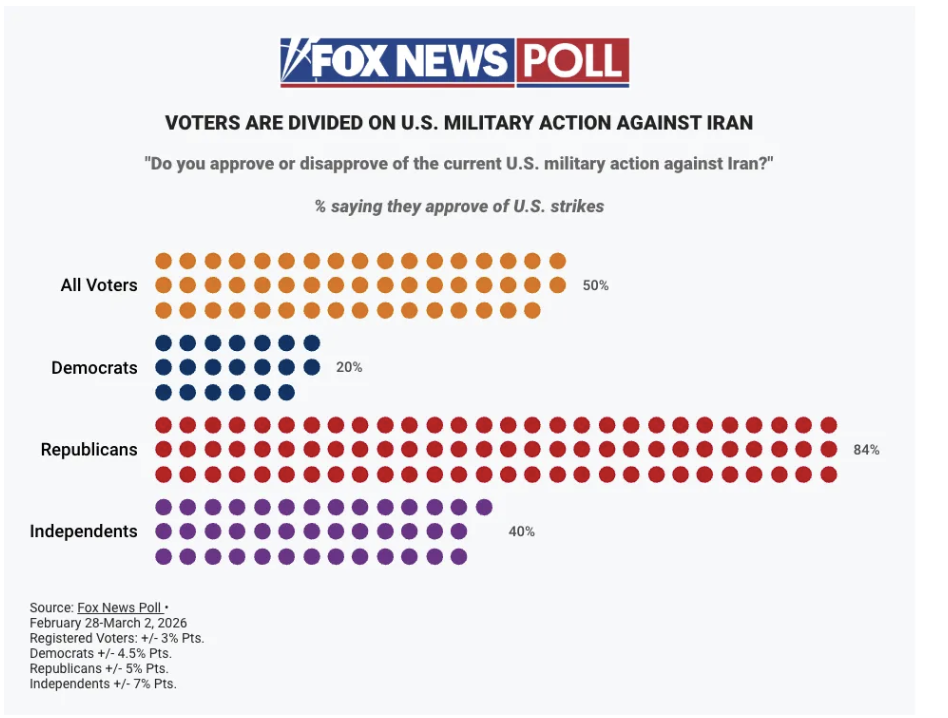
In a separate Fox News poll of more than 1,000 voting adults, more than 8 in 10 Republicans say they approve of the current U.S. military action against Iran, whereas only 1 in 5 Democrats say the same.
THE WAR POWERS RESOLUTION
Democrats — joined by Sen. Rand Paul (R-KY) — also forced a vote in the Senate on a war powers resolution on Wednesday that tests Trump’s decision to embark on a war against Iran without congressional approval. The Senate rejected the measure late Wednesday, though the House still plans to take up the resolution tomorrow.
WHAT IT IS: The 1973 resolution, first passed during the Vietnam War, prevents a president from sending troops overseas without first acquiring congressional approval. If passed, the act would require the withdrawal of US forces from the conflict unless Congress approves the operation.
WILL IT MATTER? Even if the vote on the War Powers Act were to pass the Senate, it still needs to get through a Republican-controlled House, and even then, it will be vetoed by Trump. Congress would need to muster a 2/3 majority to override the veto.