
Plus: A New Perspective On The Five Distinct Brain Phases

Good evening,
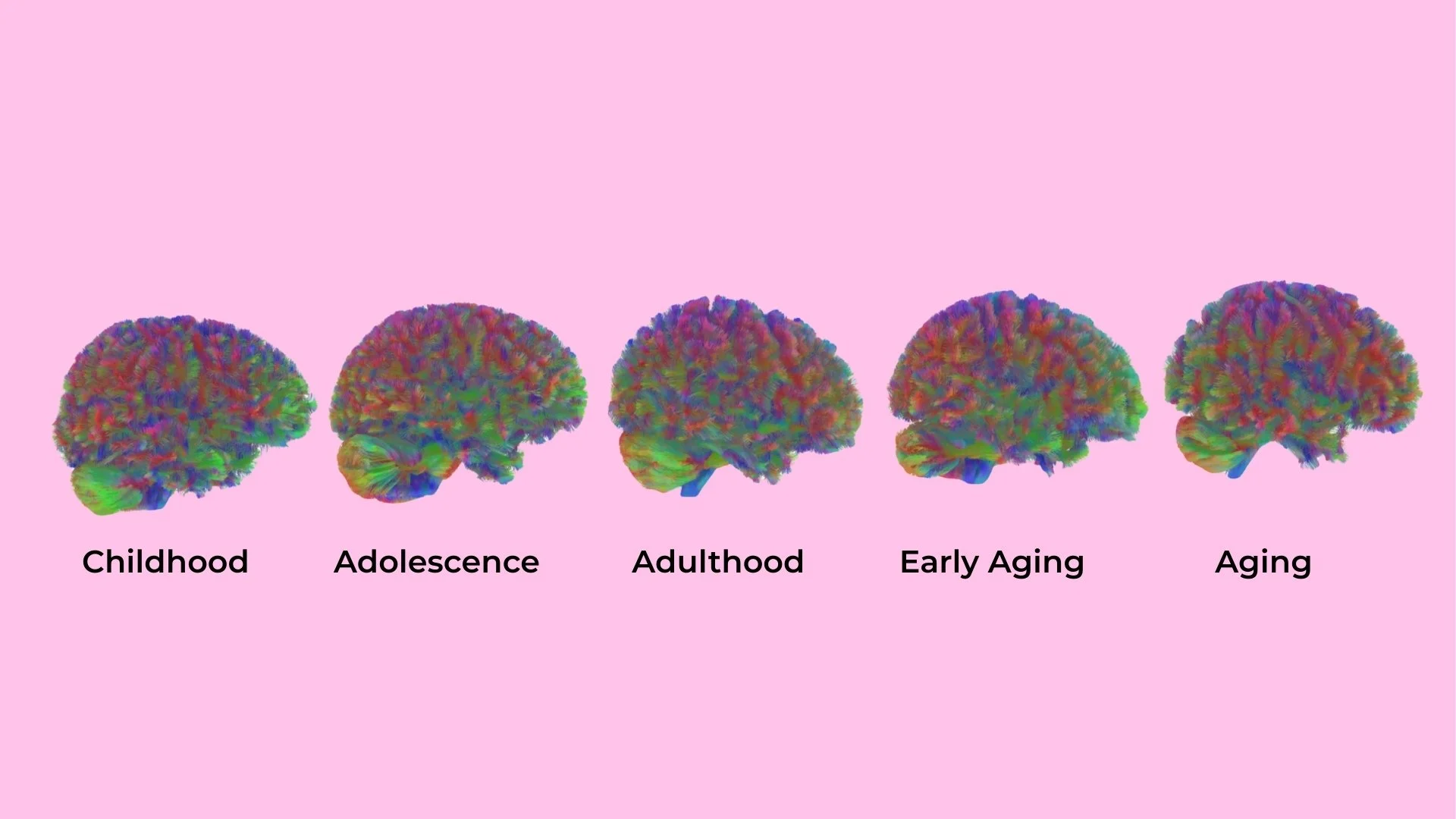
There has been a widespread belief that the brain stops developing at age 25 (scary!). But new research suggests our brains change with five distinct brain phases throughout a person’s life.
Ages 0-9: Childhood— Our brains are developing the basics, from language to motor skills.
Ages 9-32: Adolescence — Right before puberty, our brains reach peak efficiency, and this period of development lasts until our early 30s. This is also the time when our brains are most susceptible to developing mental health disorders.
Ages 32-66: Adulthood — Our longest brain period. Your brain is still changing, but there is stability when it comes to personality, behavior, and intelligence.
Age 66-83: Early Aging – The brain becomes separated into different regions, working less cohesively as a whole. Brain issues like dementia are more likely to set in. It’s not all bad, though. Aging happens slowly, and traits like emotional regulation reach their peak during this period.
Age 83+: Aging – The changes that happen during early aging speed up, and our brain focuses on prioritizing the most important information.
The study’s senior author said these phases could help researchers better understand why our brains are more susceptible to certain disorders or diseases at different periods of life. Experts recommend a good diet, exercise, sleep, and an active social life to maintain a healthy brain. 🧠💪
Sam,
Associate Producer
🚨 ONE IMPORTANT THING
AI Is Reshaping The World Faster Than Laws Can Keep Up
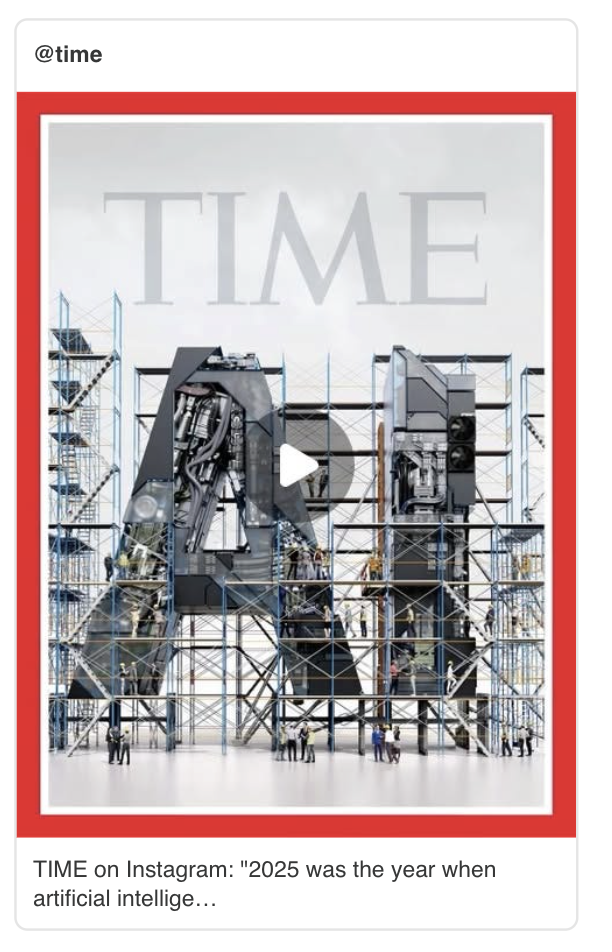
TIME magazine announced Thursday that its 2025 “Person of the Year” is “the architects of AI” — the executives and researchers who helped usher in a new era of business, culture, and community shaped by artificial intelligence.
The cover — a recreation of the iconic 1932 “Lunch Atop a Skyscraper” photo — includes Meta’s Mark Zuckerberg, AMD’s Lisa Su, xAI’s Elon Musk, Nvidia’s Jensen Huang, OpenAI’s Sam Altman, DeepMind’s Demis Hassabis, Anthropic’s Dario Amodei, and Stanford AI scholar Fei-Fei Li.
It’s the third time the magazine has selected a non-human or non-individual for the honor since its 1927 “Man of the Year” issue.
The Impact of AI: A 2025 YouGov poll found 56% of U.S. adults use AI tools and 28% use them weekly, with even higher rates among adults under 30 (74% overall; 50% weekly).
Actual usage may be higher: a Gallup/Telescope study published early this year found 99% of Americans use at least one AI-enabled product each week, though only 36% realize it.
Three years after the launch of OpenAI’s ChatGPT, the issue explores how large language models have rapidly reshaped society in both promising and unsettling ways. Here’s the state of play as we head into 2026 — a moment when AI adoption appears to be accelerating faster than governments can regulate it.
IN THE BOARDROOM
AI has shifted from “future tech” to everyday infrastructure in some workplaces, but adoption is expected to grow in the coming year.
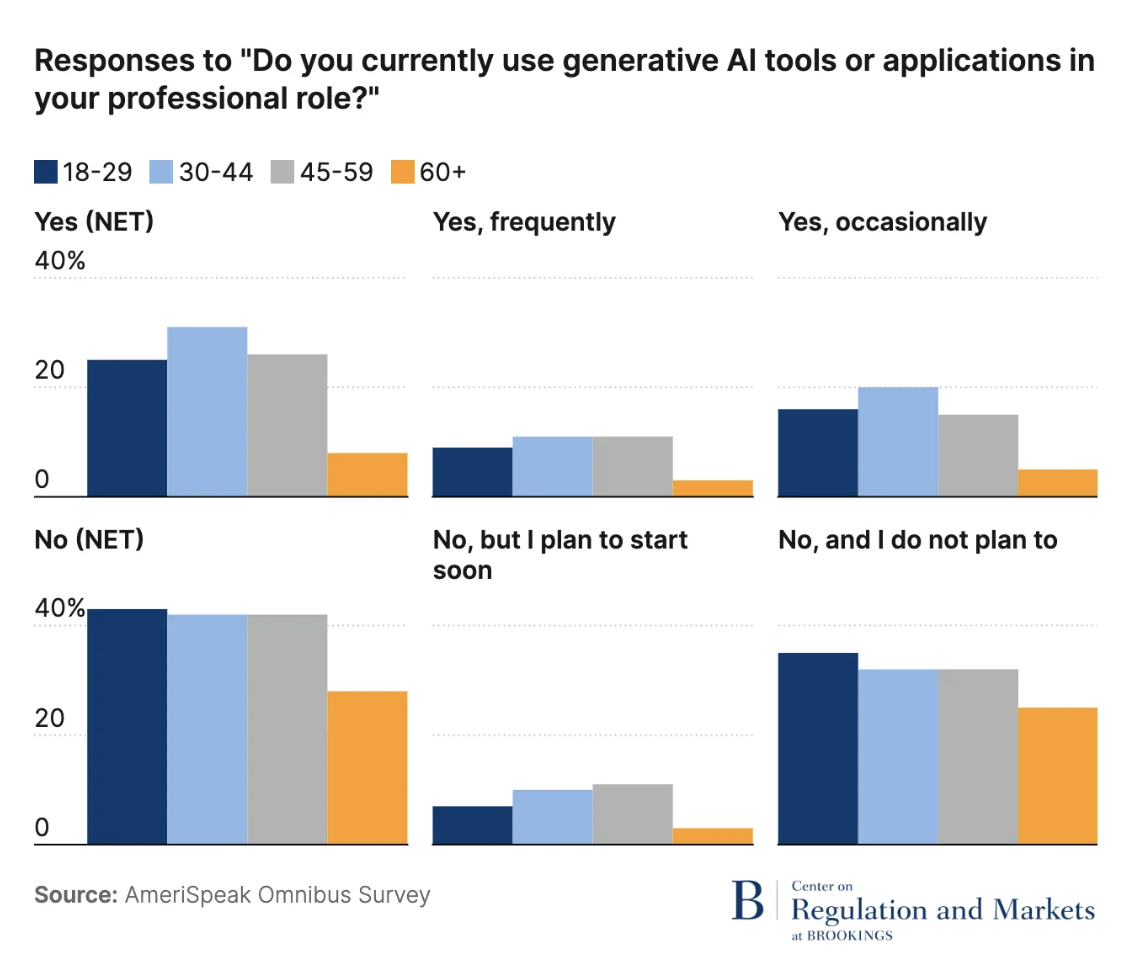
Adoption: A 2025 Brookings survey found that about one in four workers now use AI on the job — though adoption rises in employees with higher income and more education.
However, consulting firm McKinsey notes that nearly two-thirds of organizations in 2025 still have not begun scaling AI across their operations — calling now a time of “experimentation or piloting.”
White-collar cuts: Layoffs are a major part of AI anxiety. In 2025, companies announced about 55,000 AI-related layoffs.
That includes white-collar roles, like computer programmers, to customer support jobs — the U.S. has not seen this level of layoffs since the 2020 COVID pandemic and the 2008 financial crisis.
Earlier this year, Dario Amodei, the co-founder of the AI company, Anthropic, warned that AI could eliminate half of all entry-level white-collar jobs within one to five years, resulting in a 10-20% unemployment spike.
AI-washing? Experts warn that some firms are blaming AI for cuts that stem from cost-cutting and pandemic over-hiring.
Amazon, for example, doubled its workforce to 1.3 million during COVID. It recently announced 14,000 corporate job cuts — its second round of layoffs in three years.
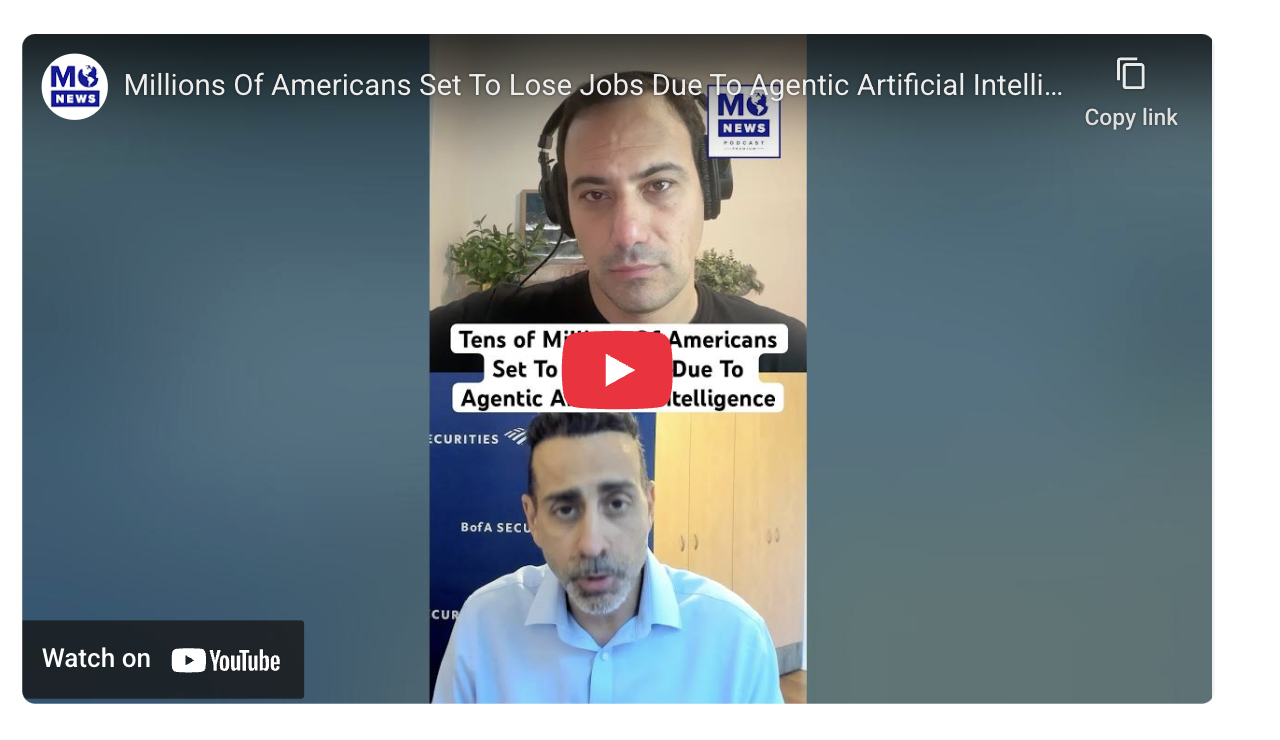
On the Mo News podcast in May, Bank of America Merrill Lynch researcher Haim Israel said that people are mainly using AI to help with their jobs right now — not to do their jobs altogether — but that could quickly change.
ENTERTAINMENT & MEDIA
AI is rapidly reshaping entertainment — from AI-prompted playlists on Spotify that include AI-generated music (remember that AI country music hit), to generated “actress” Tilly Norwood making waves in Hollywood, to brands like Coca-Cola and McDonald’s releasing AI-created holiday ads.
Over on social media, feeds have become flooded with generative videos after the release of OpenAI’s Sora 2 AI video app in September. Currently, guardrails for flagging AI content can be easily ignored.
More news today: On Thursday, Disney announced a billion-dollar investment in OpenAI. In exchange, around 200 characters — including Mickey Mouse, Darth Vader, and Cinderella — can be used on Sora.
CEO Bob Iger assured that the move will not threaten Disney’s voice actors and artists: ”We are not including name and likeness, nor are we including character voices,” Iger explained. “So in reality, this does not in any way represent a threat to the creators at all. I think it honors them and respects them, in part because there’s a license fee associated with it.”
Another announcement: The Washington Post debuted “Your Personal Podcast” this week, which uses AI to generate custom news shows with topics, hosts, and the length of your choice.
The legal: The OpenAI deal comes as Disney sent a cease-and-desist letter to Google on Thursday for allegedly using Disney’s copyrighted work to train its AI services without its permission.
AI company Anthropic agreed in September to pay $1.5 billion to authors and publishers after a judge ruled in June that the A.I. company illegally downloaded millions of pirated books to train its model, Claude.
More AI companies are paying media outlets to access their content — especially breaking news.
PERSONAL RELATIONSHIPS
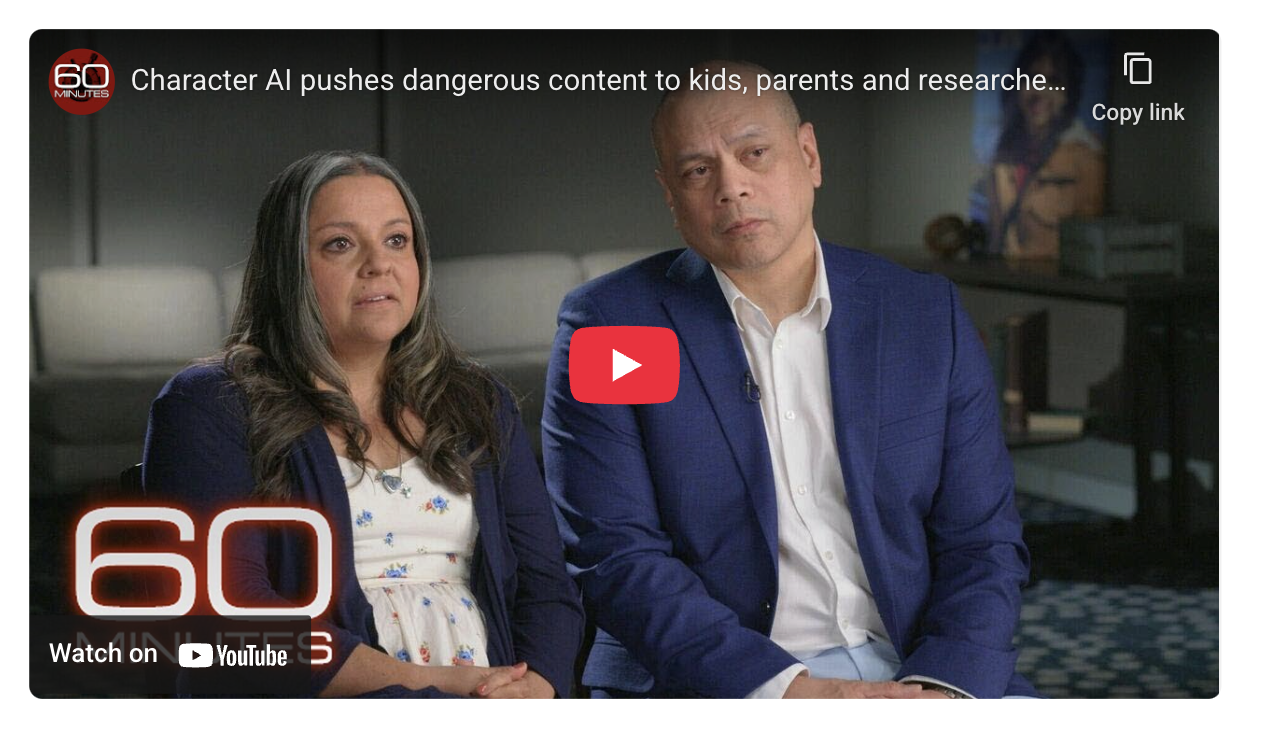
A new Pew survey finds 64% of U.S. teens use AI chatbots like ChatGPT or Google Gemini, and 28% use them daily. A Common Sense Media survey from this summer found that nearly three-quarters of teens (72%) say they use AI for companionship. That has parents alarmed.
The parents of teenagers who died by suicide testified before Congress in September, alleging that Character.AI and ChatGPT failed to flag their kids’ suicidal comments. Others claim AI chatbots engaged in sexually inappropriate interactions with their minors.
A New York teenager calls AI “inescapable” at school in an Atlantic piece.
On the other hand, there are promising signs that AI can actually help alleviate loneliness and isolation among older adults. A pilot study at a New York senior living community found that residents who spoke with an AI companion named Meela at least once a week showed improvements in depression and anxiety after a month.
BOTTOM LINE
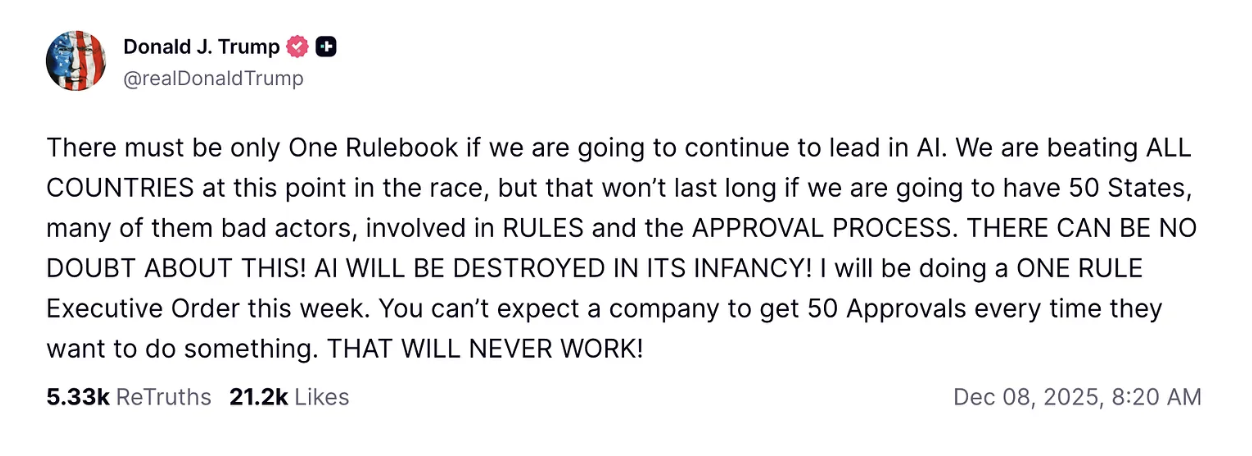
Like any new technology, AI comes with both upsides and downsides. One lingering question is how regulators will help manage the downsides. But, some policymakers are skeptical about any rule-making, calling this AI moment a “race with China.”
On Monday, President Trump announced on Truth Social that the White House would issue a “one rulebook” for AI regulations, saying an executive order could come as soon as this week — a move that would upend states’ individual efforts to set their own safeguards. A draft of the order appears to direct the U.S. attorney general to sue states with their own AI laws.
🚨 The president does not have power to force states to repeal regulations. Congress could pass a federal law that prevents certain types of state regulations — but something like that has been killed in the past.
OpenAI’s Sam Altman has warned that a patchwork of state-by-state regulation could “slow innovation without improving safety.”
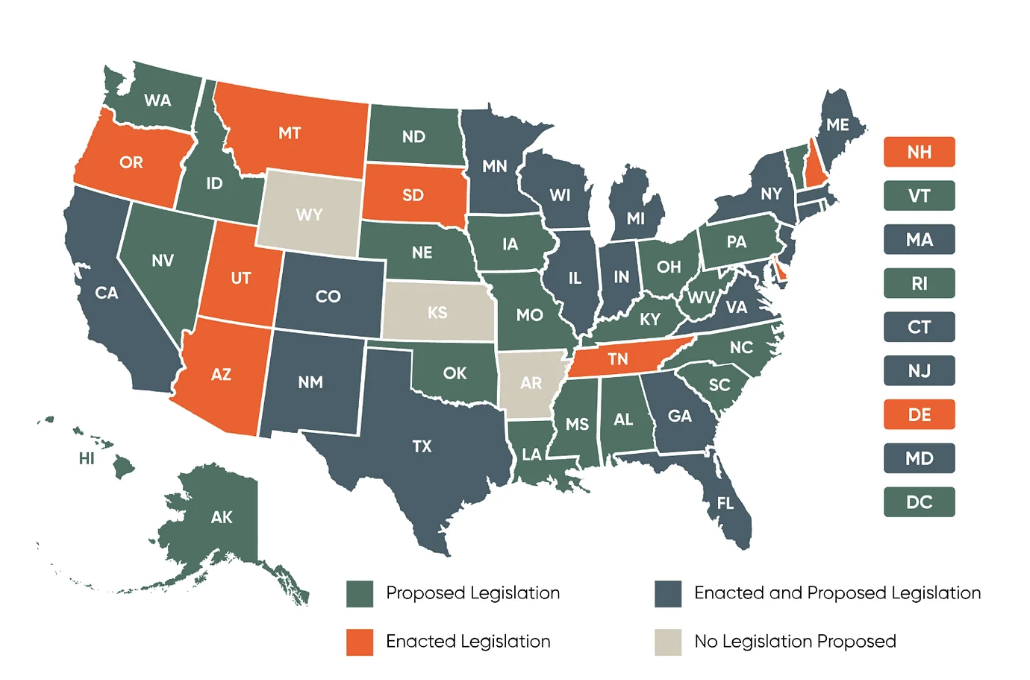
Brookings found that 47 states have introduced some form of AI regulation this year. Most bills centered around manipulated images and child sexual abuse material, but none have passed.
The U.S. Congress passed a bill targeting AI generated “revenge porn” this year.

Photoshop, Now Inside ChatGPT

Adobe just brought Photoshop’s powerful editing tools straight into ChatGPT. Blur
backgrounds, fix lighting, retouch photos, or add creative effects just by typing what you want.
Plus: Acrobat and Express are here too, helping you edit PDFs and designs in seconds.
⏳ THE SPEED READ
🚨NATION
Judge orders immediate release of Kilmar Ábrego García from immigration detention (ABC)
Justice Department fails to reindict Letitia James for a second time (CNN)
Trump rolls out $1 million gold card for wealthy foreigners (MO NEWS)
Charlie Kirk murder suspect appears in court as judge weighs degree of media access (CBS)
🌎 AROUND THE WORLD
“Don’t Worry, Be Happy”: Maduro sings, dances as Trump says his days are numbered (MO NEWS)
Germany asks U.S. to join Ukraine peace talks in Berlin (POLITICO)
Over 400 civilians killed in fighting in eastern Congo, despite peace deal (AP)
Half a million flee as deadly Cambodia-Thailand border clashes escalate (GUARDIAN)
📱BUSINESS, SCIENCE & TECH
Open AI, Microsoft face lawsuit over ChatGPT’s alleged role in Connecticut murder-suicide (AP)
Fresh warning as ByHeart baby formula botulism outbreak sickens more than 50 babies (INDEPENDENT)
Apple’s AirPods Pro 3 just dropped below $200 for the first time (VERGE)
NASA says Maven spacecraft that was orbiting Mars has gone silent (CBS)
🎬 SPORTS & ENTERTAINMENT
Jennifer Lawrence, Josh Hutcherson to return for ‘Hunger Games: Sunrise on the Reaping’ (HOLLYWOOD REPORTER)
NASCAR settles federal antitrust case filed by 2 teams (ESPN)
Hollywood director convicted of scamming $11M from Netflix and going on lavish spending spree (AP)
Eurovision winner Nemo to return trophy in protest of Israel taking part in 2026 (GUARDIAN)
ICYMI FROM THE 📲
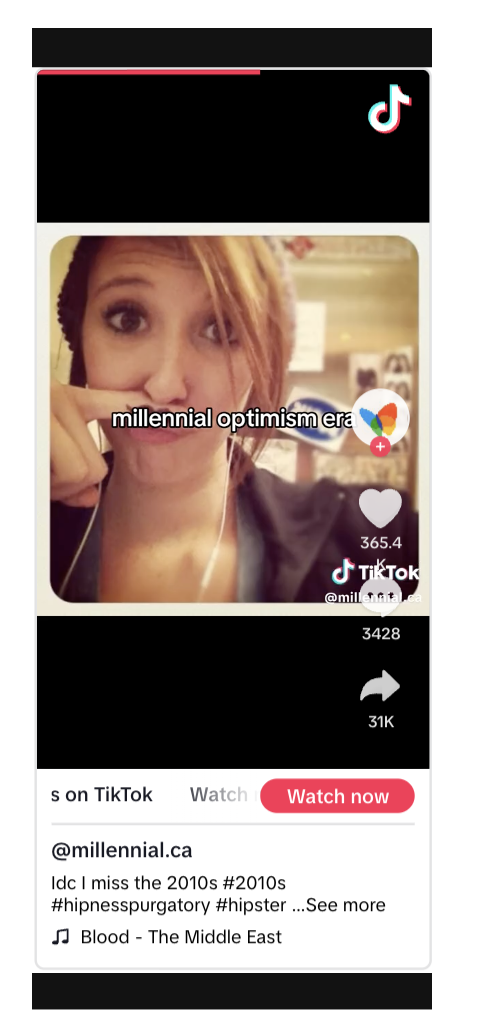
In case you missed it… It was an era of ukuleles, handlebar mustaches, and fewer worries…at least according to TikTok.
Gen Z is romanticizing early 2010s millennial culture online in a new trend known as #MillennialOptimism. Videos include shots of Williamsburg cafés, mood boards of quirky hipster fashion, and even parodies of the era’s indie folk songs.
They’re not the only generation looking back at the past with Instagram-filtered goggles. A new Pew Research Center survey shows that 45% of U.S. adults would prefer to live in the past, if they could choose, compared to only 14% who said they would rather live in the future.